
From a brand brochure to a clinical trial recruitment engine.
We designed and engineered a custom recruitment platform for a Central Florida research site: condition pages patients can actually understand, prescreening built around consent, a secure enquiry inbox wired into their CTMS, and AI that is not allowed to make things up.
The client
Novum Research
Novum Research is a dedicated clinical research site in Clermont, Florida, running Phase II–IV studies across internal medicine, gastroenterology, cardiology, endocrinology, dermatology and pulmonology for pharmaceutical sponsors and CROs.
For a research site, the website is not a brochure. It is the front door of recruitment, and recruitment is the business. Every enrolled participant starts as a stranger reading about their condition, and every sponsor decides whether a site is worth a feasibility call before anyone picks up the phone.
Novum came to Incep Digital with a site that described its vision well, but gave a patient looking for a study very little to go on: no page for their condition, no clear sense of whether they might qualify, and no obvious next step.
Where they started
A site that talked about research,
not the people it needed to reach.
We audited the existing Squarespace site page by page, against how a patient searches for a study and how a sponsor shortlists a site.
Written for investors, not patients
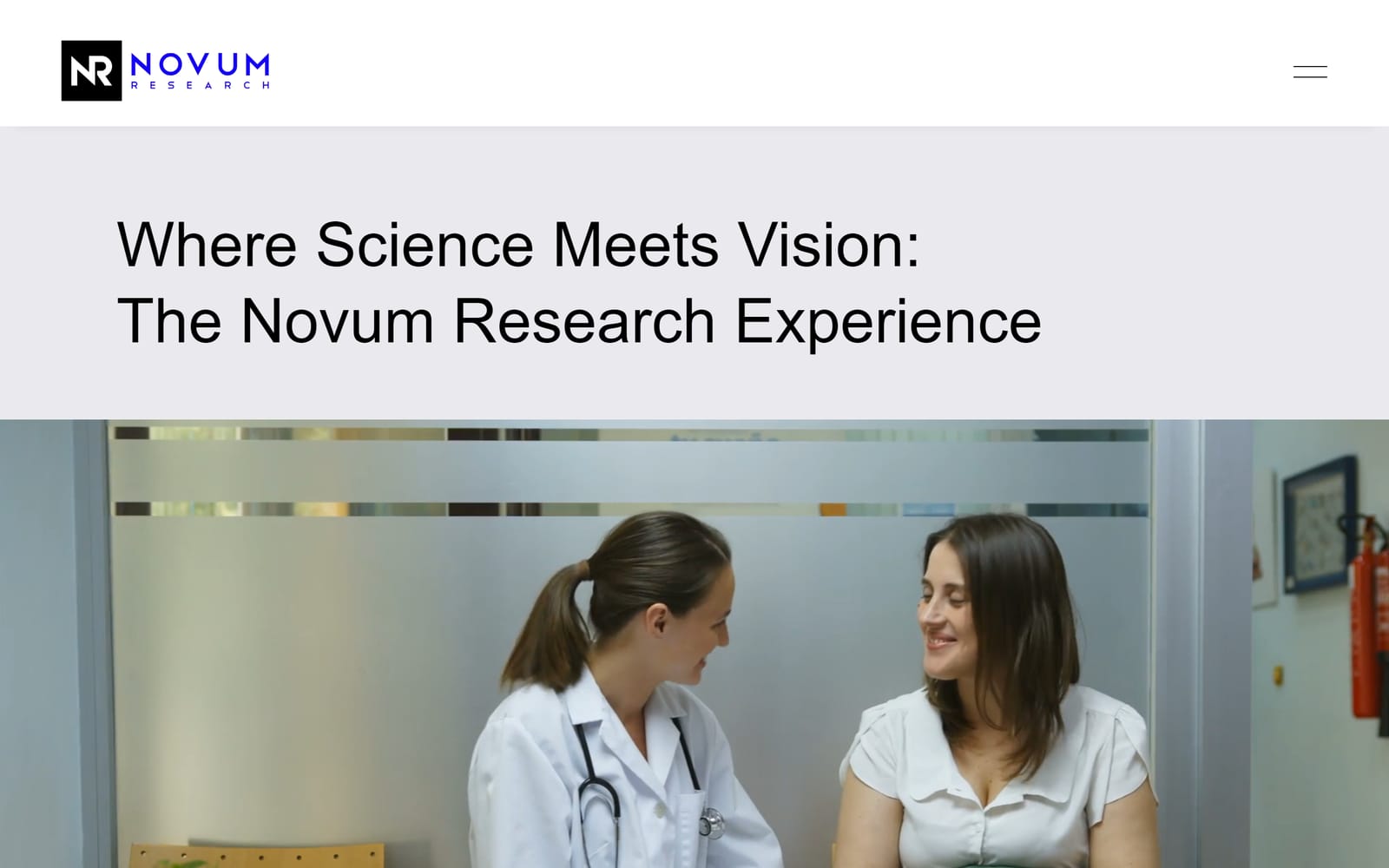
“Where Science Meets Vision”, “trailblazers”, “a revolutionary movement.” Beautiful language that never answered the patient’s questions: is there a study for my condition, would I qualify, and what actually happens if I say yes?
Trials buried in a single text page
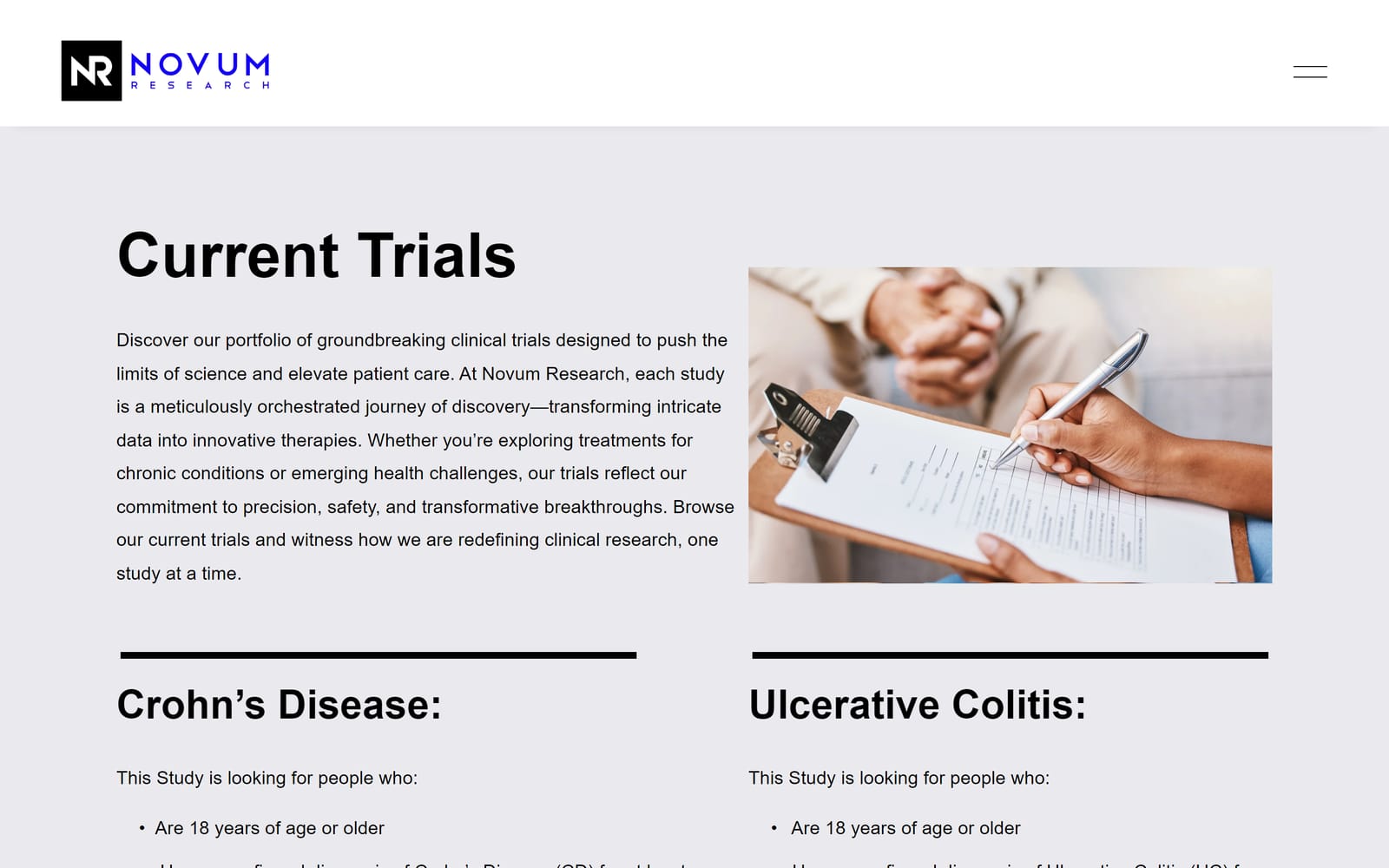
Current studies lived as short bullet lists on one page. No page per condition meant nothing for Google to rank for “ulcerative colitis clinical trials near me”, and nowhere to point a paid campaign.
One generic sign-up form
Every enquiry came through the same form, detached from any condition, with no status, no consent record and no hand-off to the site’s clinical trial management system.
Template leftovers eroding trust
A shopping cart link on a clinical research site, and news articles still living at addresses like “blog-post-title-one”. Small things, but patients and sponsors both notice.
Sponsors got the same vague pitch
No capabilities, no timelines, no evidence of recruitment strength. The audience that funds the studies read the same brand copy as everyone else.
No way to grow with the pipeline
Every new study meant hand-editing pages. No Spanish for Central Florida’s large Hispanic community, and no way for the team to publish safely without a web designer.
The strategy
Four shifts that turned a website
into recruitment infrastructure.
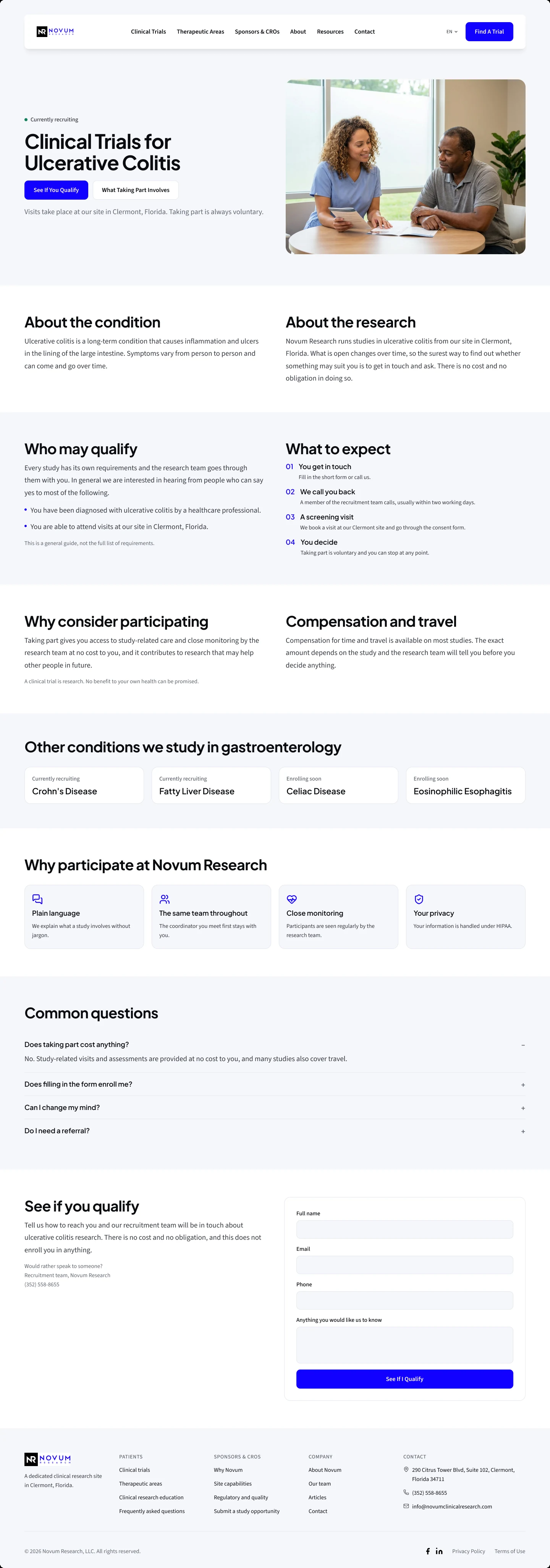
Every page answers what a nervous, newly diagnosed reader needs first: what the condition is, who may qualify, what taking part involves, and that it is always voluntary.
Evergreen, search-friendly condition pages that stay live between studies. Their “recruiting” status updates itself from the private study records behind them.
Prescreening, a secure inbox with statuses and notes, alerts to the recruitment team, and automatic hand-off to eClinPro, Novum’s CTMS.
Data minimisation, consent records, least-privilege access and consent-gated tracking were built into the product, not bolted on before launch.
The finished site
Every page, top to bottom.
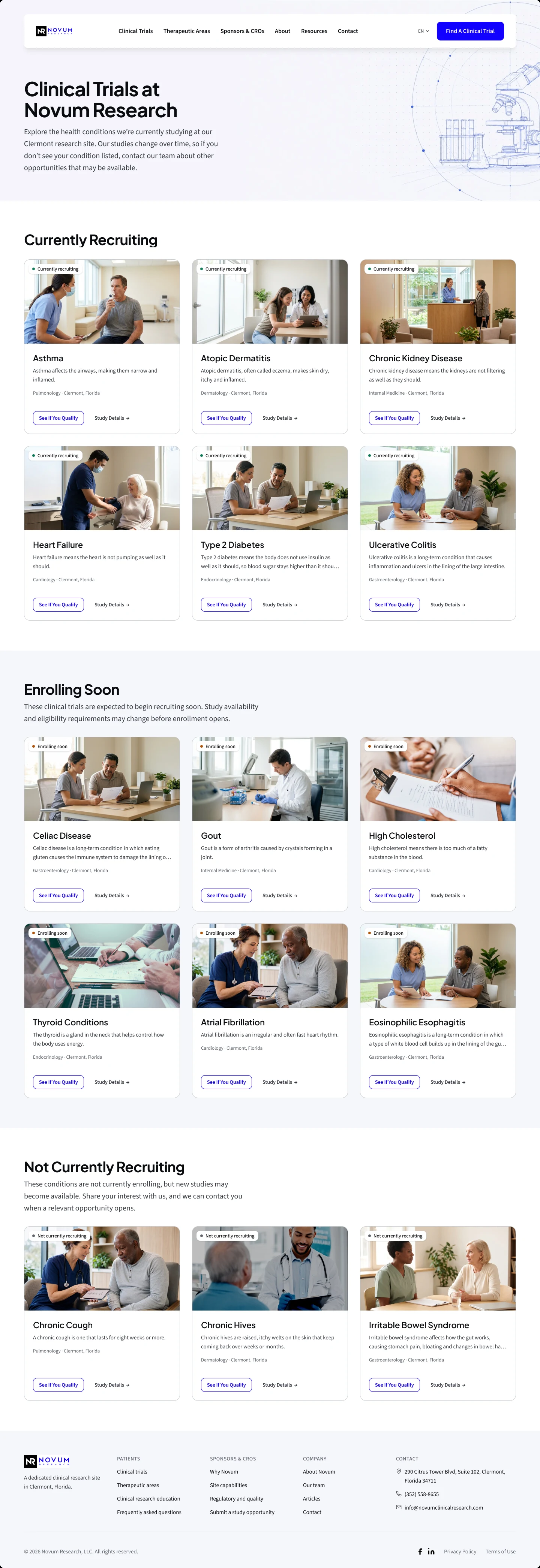
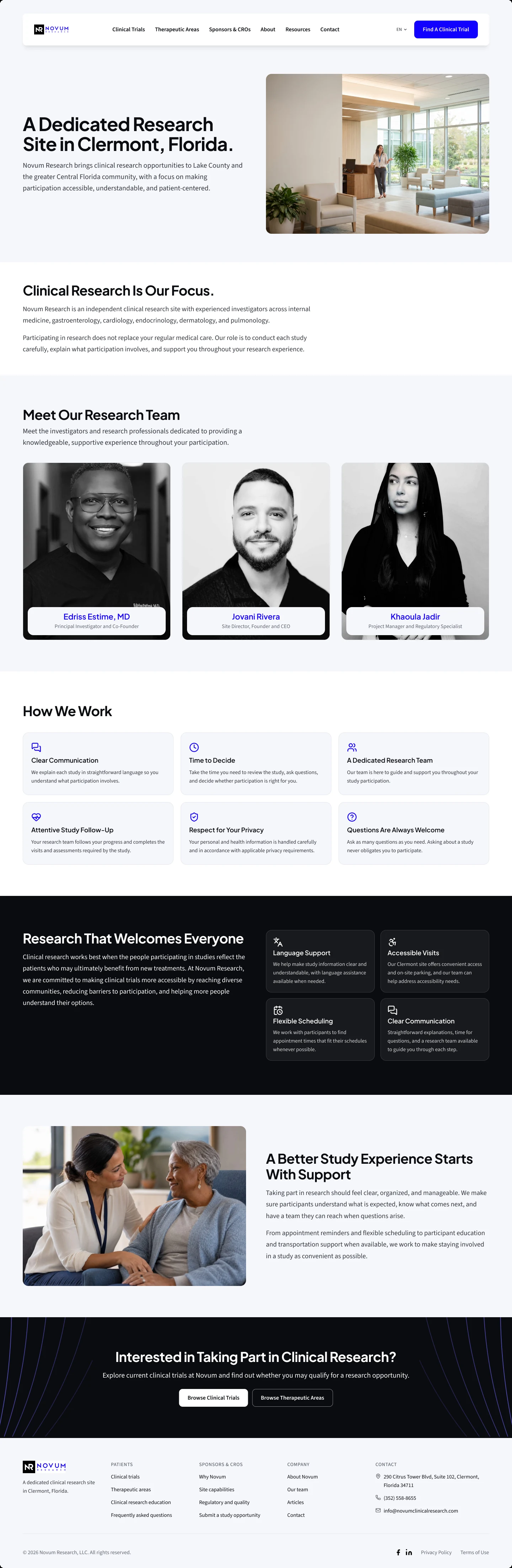
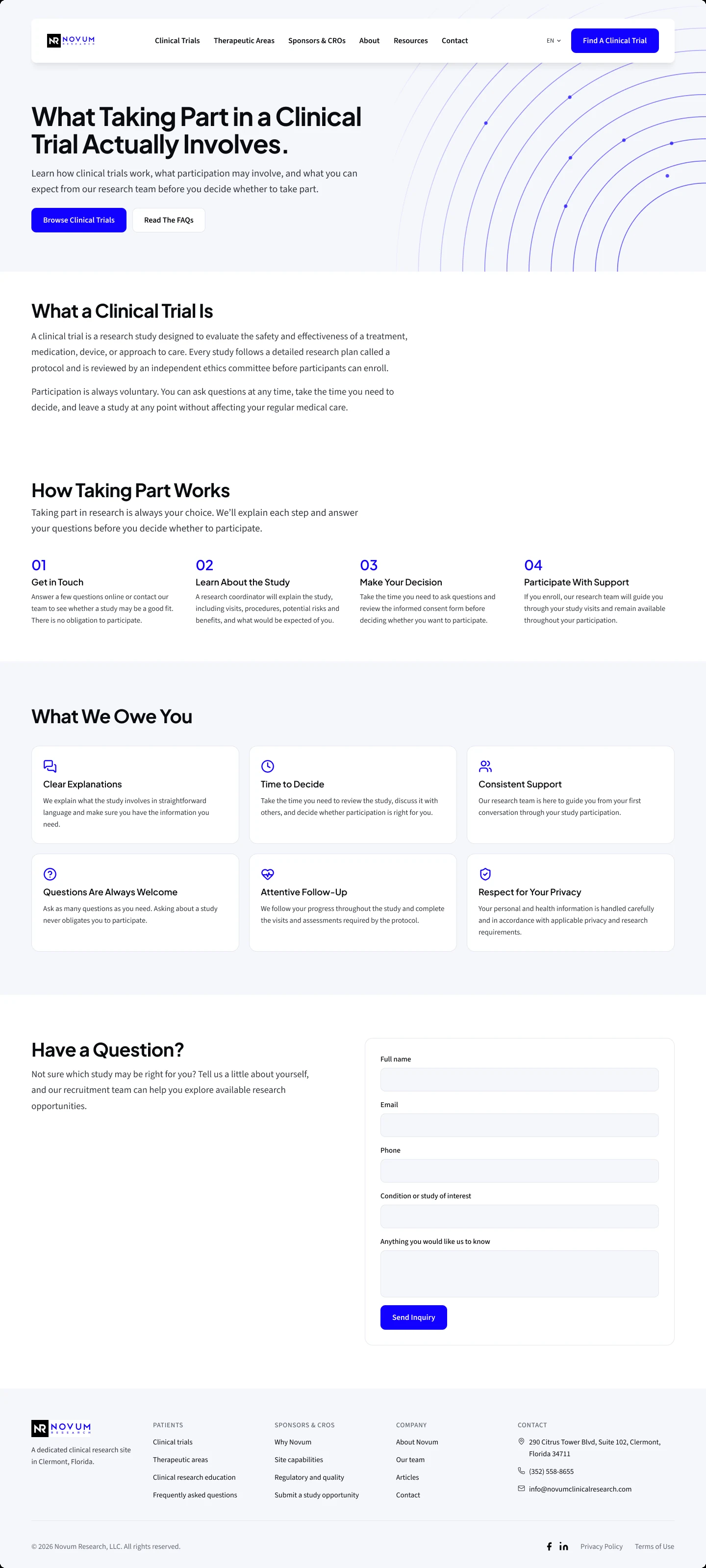
The sections below go deep on how it works. Here is the site as patients and sponsors actually meet it: hover over any page to scroll through it in full.
 Hover to scrollTap to scroll
 Hover to scrollTap to scroll
 Hover to scrollTap to scroll
 Hover to scrollTap to scroll
 Hover to scrollTap to scroll
 Hover to scrollTap to scroll
What we designed and built
Two experiences on one platform:
the site patients see, and the system the team runs.
Not a theme with a form plugin. A purpose-built Next.js platform with its own content model for conditions, studies, forms and enquiries, and an admin designed for coordinators rather than web developers.
Condition pages
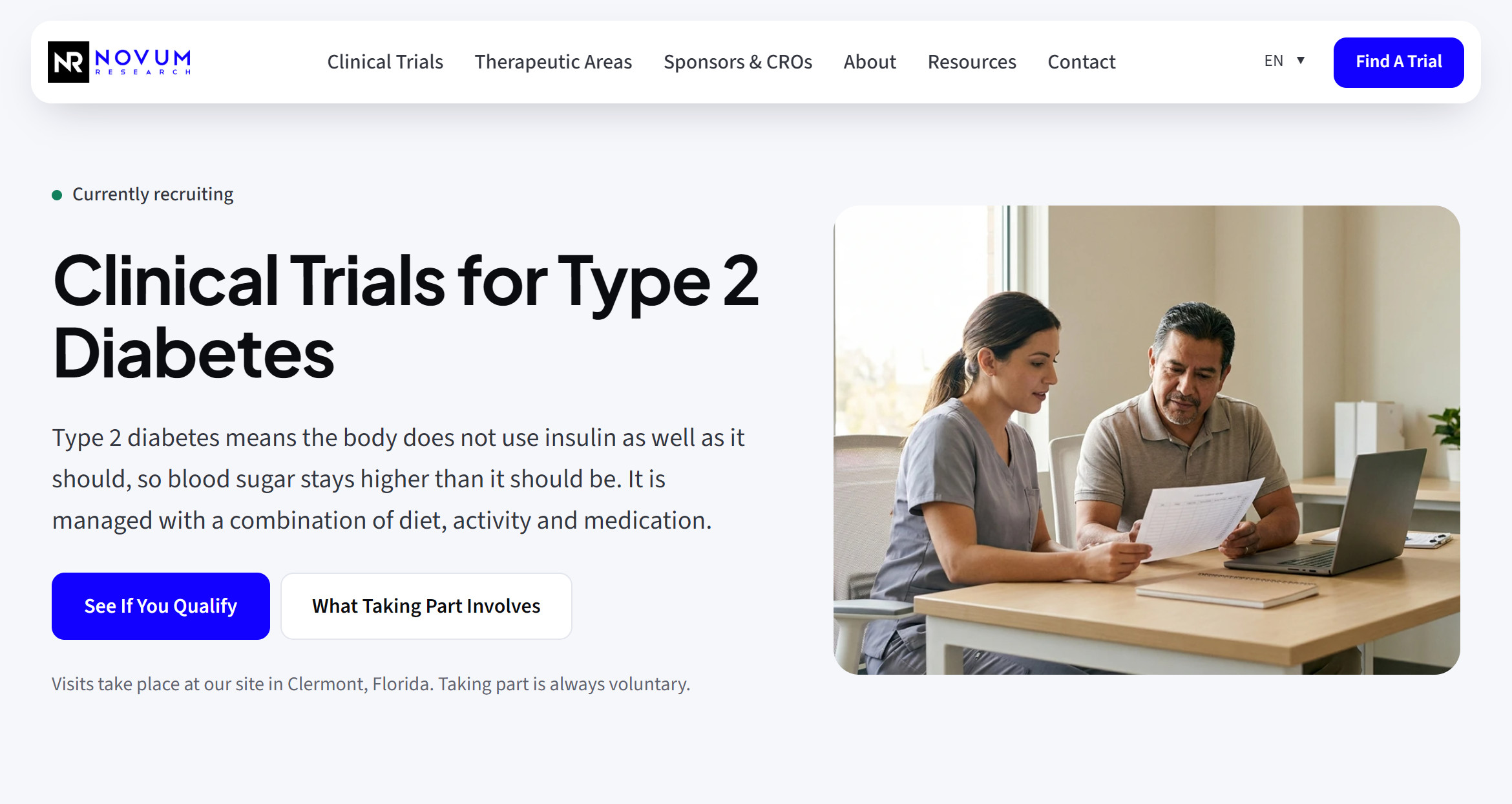
One clear, evergreen page for every condition Novum recruits for.
Each condition gets its own page at /clinical-trials/type-2-diabetes, written in plain language and structured around the questions people ask before they enquire. Pages stay live between studies, so they keep ranking, and they double as landing pages for paid campaigns.
- Recruiting, enrolling soon and not recruiting labels set automatically by the private study records
- Four page layouts, including a form-alongside version built for paid traffic
- Grouped into six therapeutic area hubs for browsing and internal linking
Prescreening
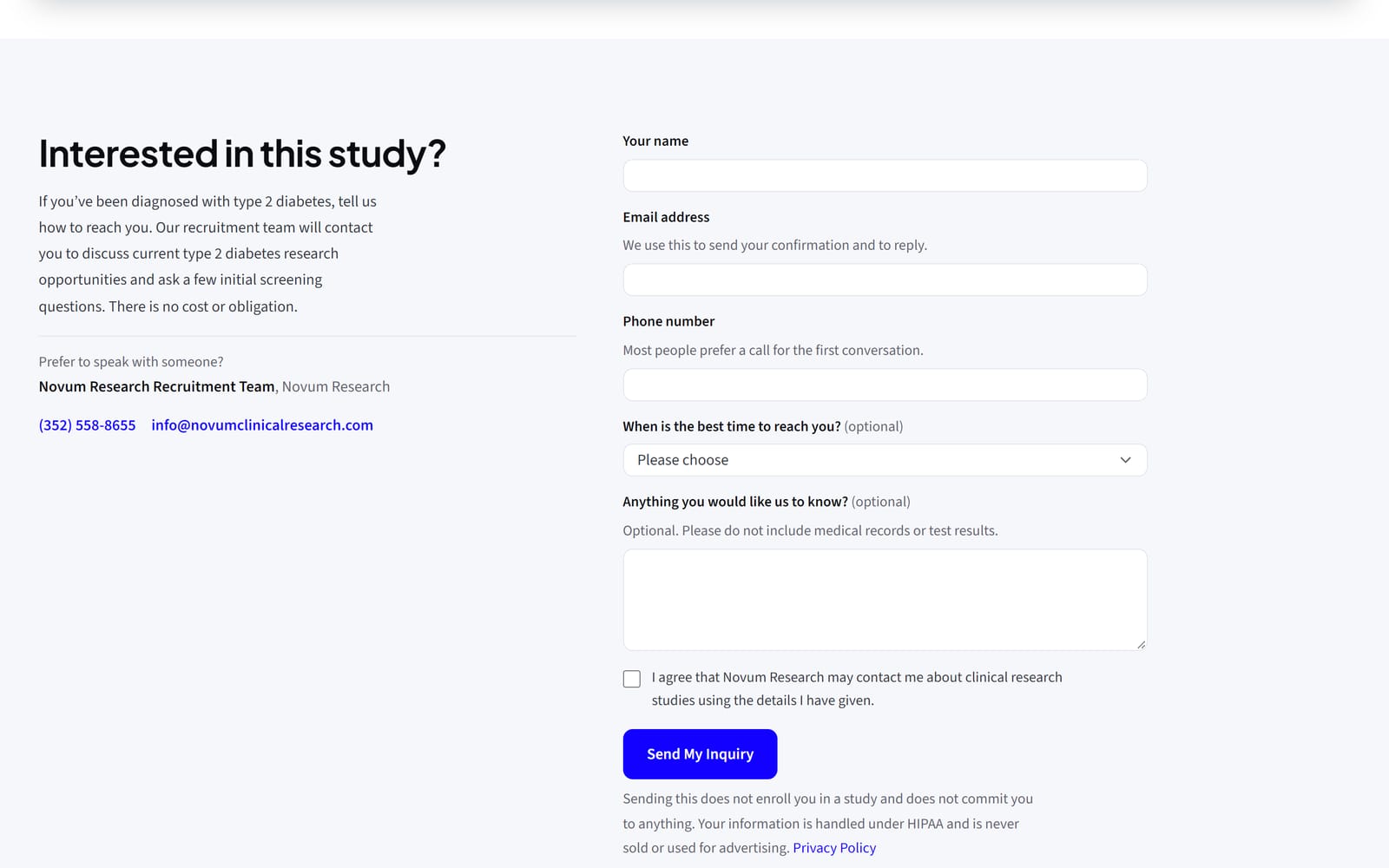
Short forms designed around consent, not data collection.
Coordinators build a prescreening form per condition from a guided editor. Visitors answer a handful of questions right on the condition page, with the exact consent wording they agreed to stored alongside their enquiry.
- A hard limit of eight questions, enforced as a privacy control
- Draft and published versions, so an unfinished edit never reaches a visitor
- Every enquiry keeps the questions and consent text exactly as they were shown
Recruitment inbox + eClinPro
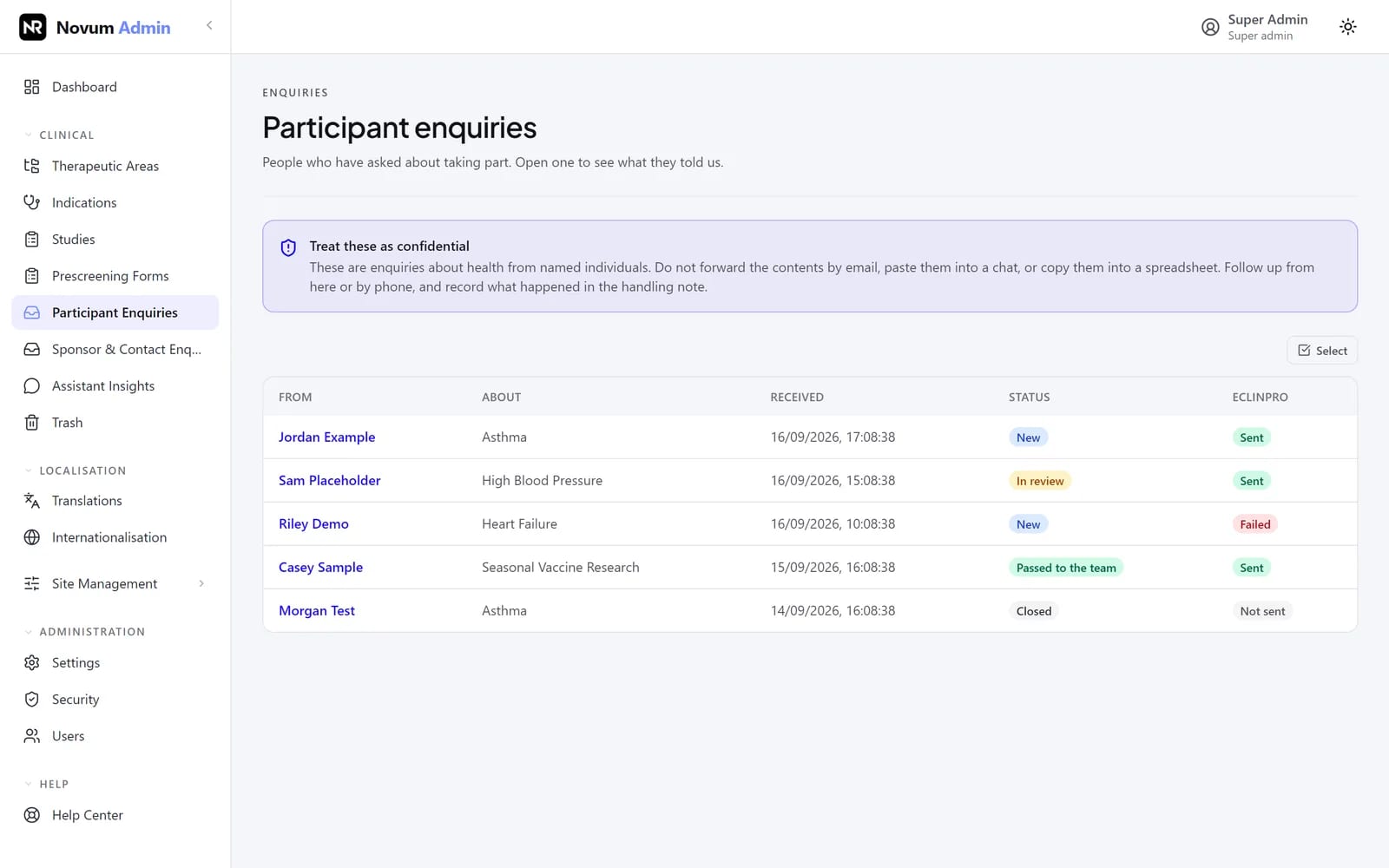
Every enquiry lands in a secure inbox and flows straight into the CTMS.
Enquiries arrive in a confidential inbox with statuses, handling notes and a full consent record. In the background the platform forwards each lead to eClinPro, Novum’s clinical trial management system, routed to the right study and site automatically.
- Only answers explicitly mapped to eClinPro fields ever leave the site
- Leads routed to the enrolling study first, with clear reasons shown when one cannot be sent
- Staff alerts carry a secure link, never the participant’s answers
AI, with guardrails
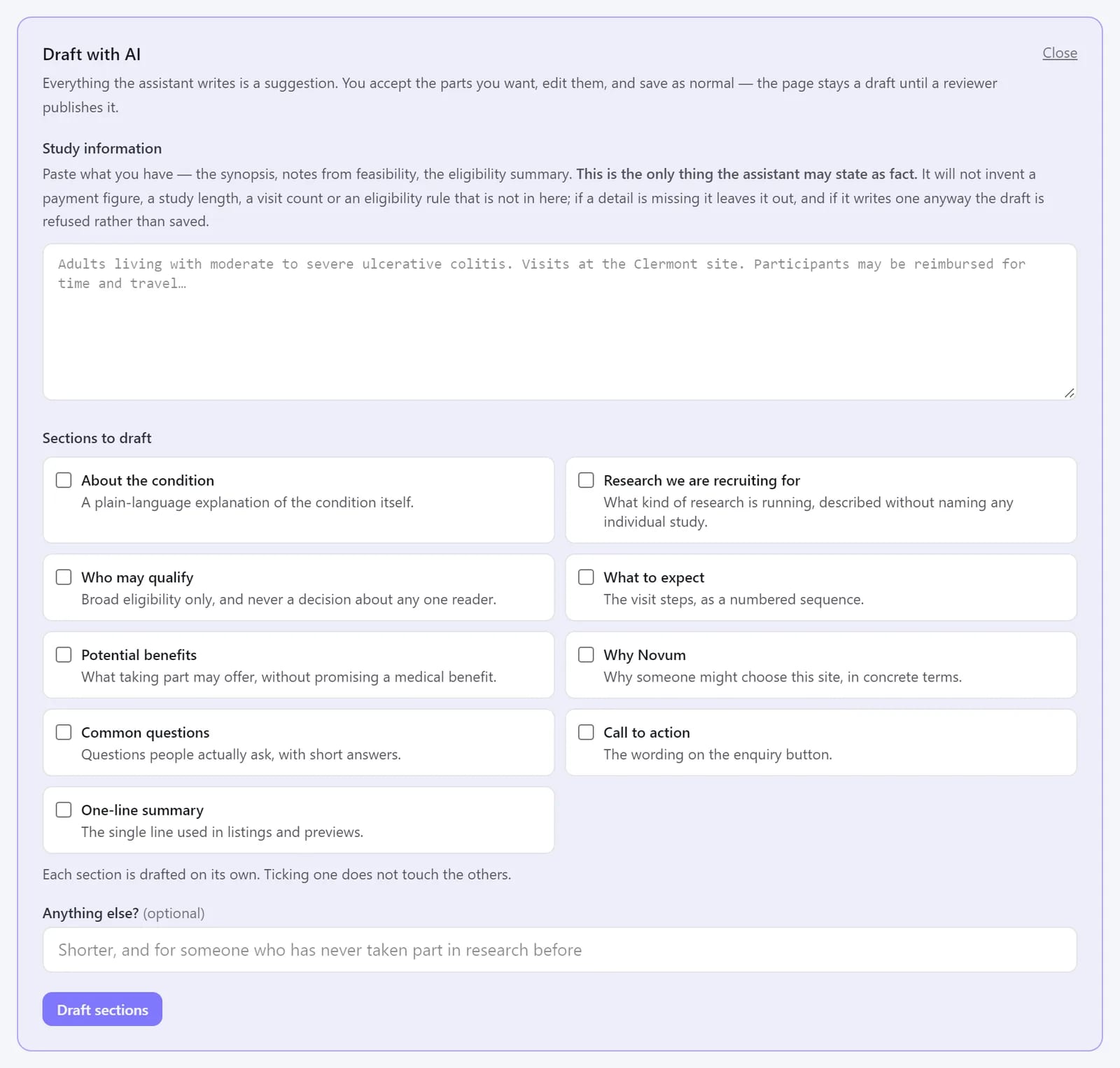
AI that drafts from the study facts, and refuses to invent any.
Coordinators paste a study synopsis and the assistant drafts plain-language sections for the condition page. If a draft mentions a payment figure, visit count or eligibility rule that was not in the source, the whole draft is rejected and the invented claims are listed. Nothing is published without a human.
- Section drafting, plain-language rewrites, SEO metadata and Spanish first drafts
- AI image generation that never depicts symptoms, needles, medication or children
- Participant answers are never sent to an AI provider
Public and private, by design
Protocol detail stays private. The public page stays safe.
Sponsor names, protocol numbers and detailed inclusion criteria live on internal study records that are never published and sit behind their own permission. The public page shows broad eligibility only, yet still reflects exactly what is enrolling.
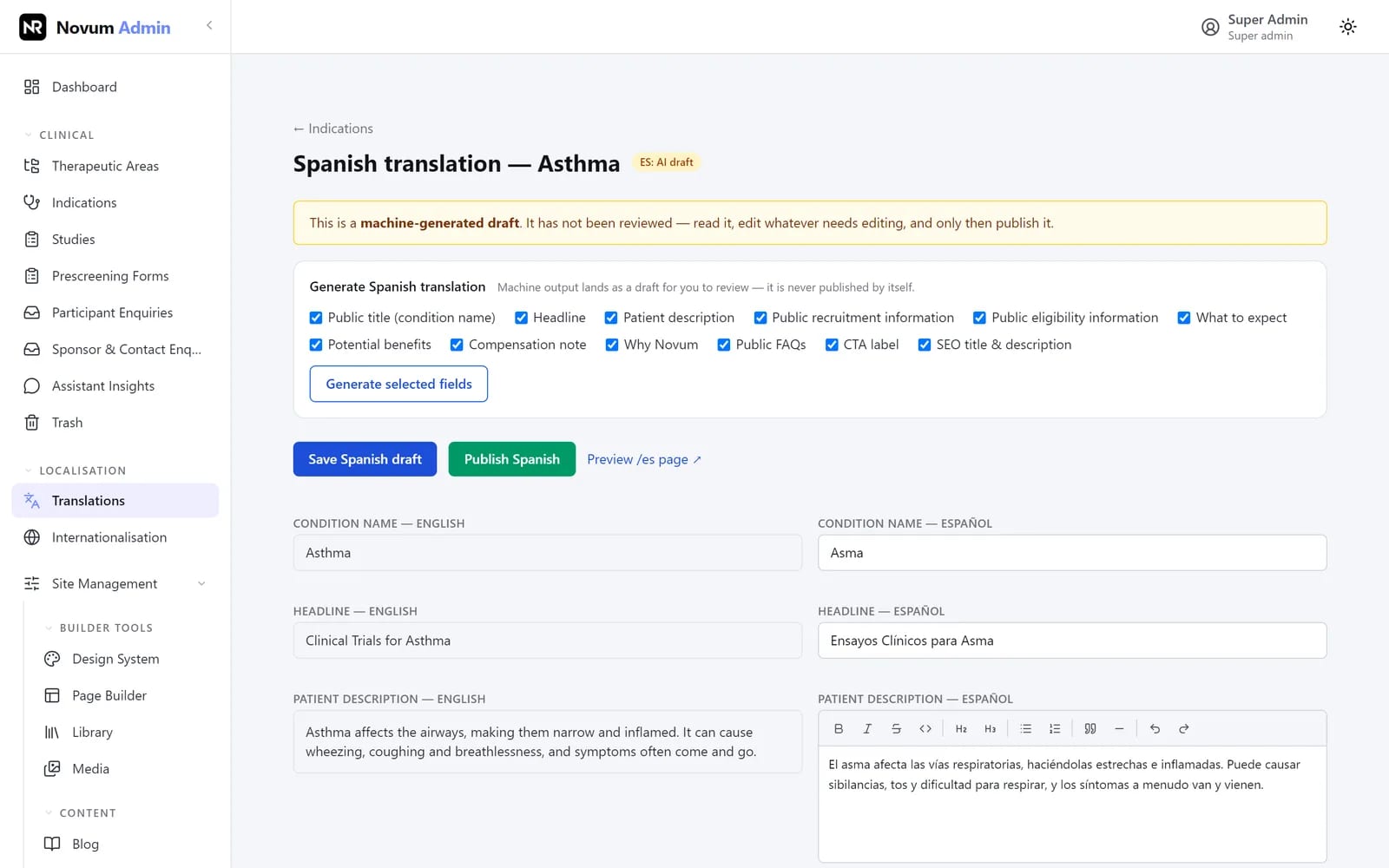
English and Spanish
Built bilingual for Central Florida.
A full translation workflow with side-by-side editing, AI first drafts that always land as drafts, outdated-translation warnings when the English changes, and a Spanish site at /es. Consent and prescreening wording is translated by hand, because compliance language should be.
For sponsors & CROs
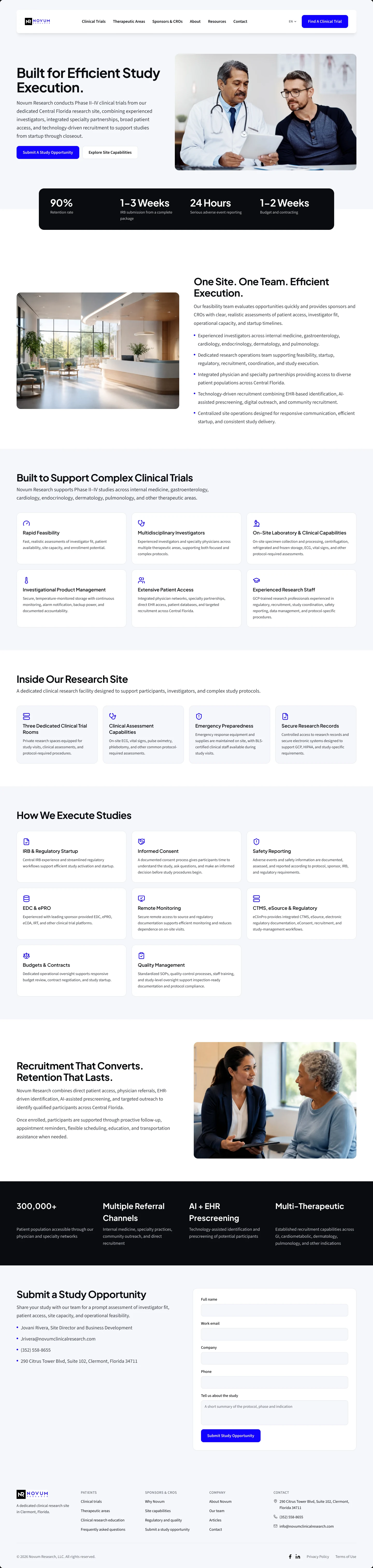
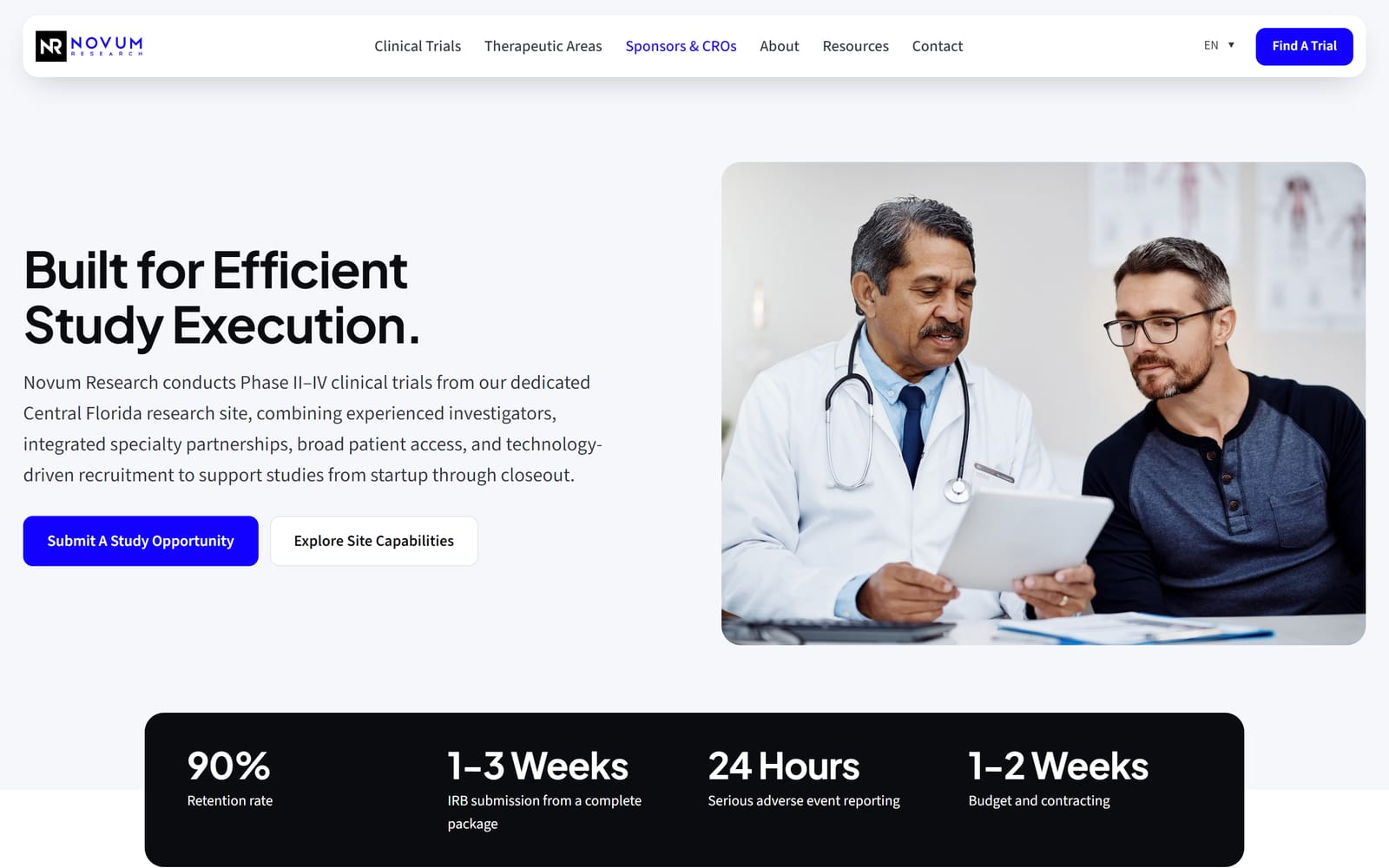
A sponsor page that sells the site, with numbers.
The sponsor journey got its own story: site capabilities, therapeutic expertise, startup and contracting timelines, retention, and a direct route to submit a study opportunity. The enquiries land in their own inbox, separate from participant data.
The enquiry journey
From “is there a study for me?” to a coordinator’s call list.
Finds their condition
Search, ad or referral lands on a plain-language condition page.
Answers a few questions
A short prescreening form, with consent recorded word for word.
Enquiry stored securely
Saved first, confirmation sent, team alerted without any answers in the email.
Lead sent to eClinPro
Mapped fields only, routed to the enrolling study and site.
Coordinator calls
Status and notes tracked until the person is screened or closed.
Mobile-first
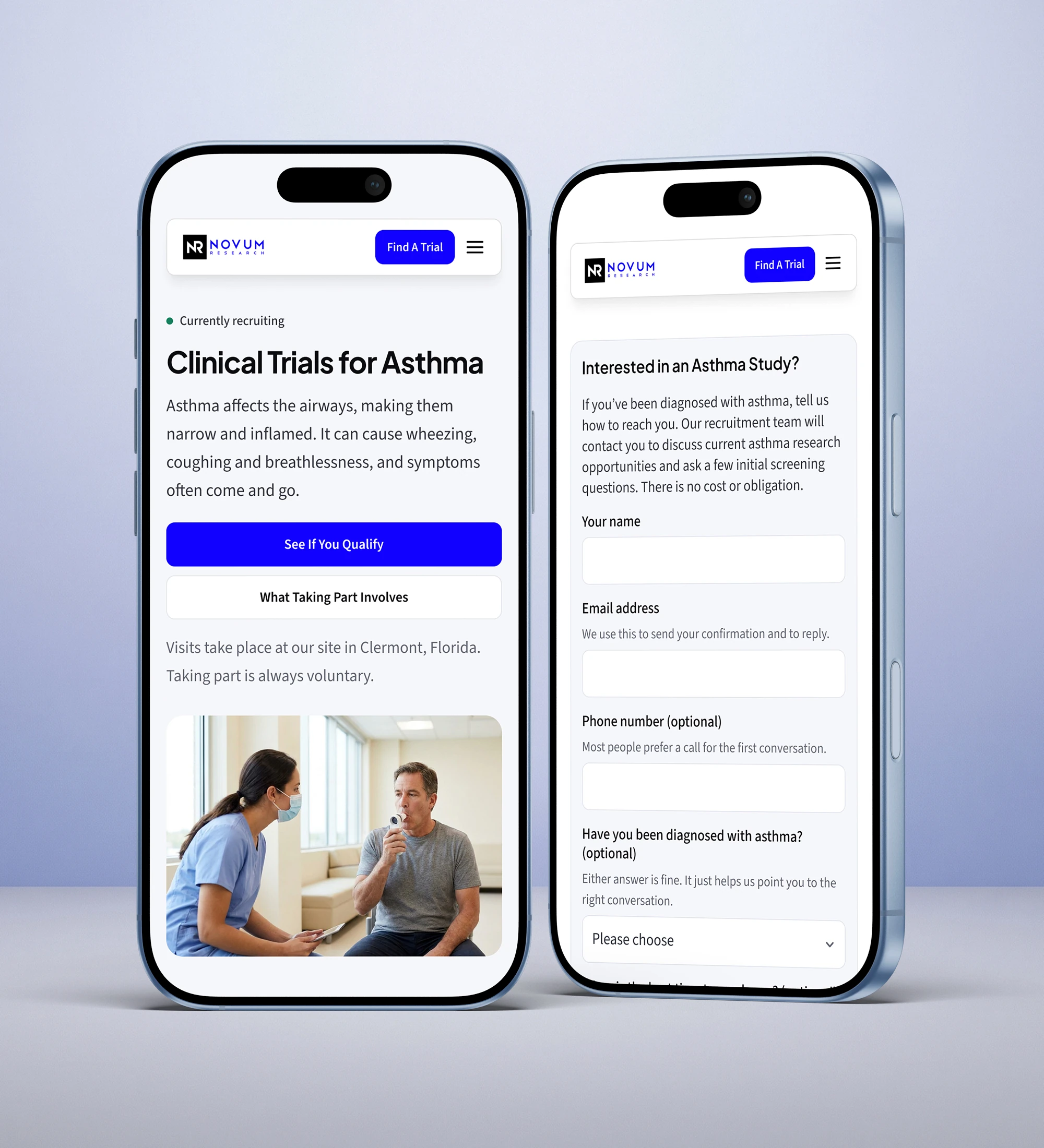
Designed for the phone
in a waiting room.
Most people first read about a clinical trial on their phone, often straight after an appointment or from a social ad. Condition pages, the form and the consent step were designed for a thumb and a small screen first, with large tap targets, readable type and nothing hidden behind hover.
The page also carries an accessible “Ask a question” assistant that answers only from published content and hands anything urgent straight to a person.
Privacy and trust
Health data changes the rules.
So we wrote them into the product.
A condition page view, an enquiry about a bowel disease, an answer about a diagnosis: on this site every data point is sensitive. The platform treats it that way by default.
Data minimisation
An eight-question cap, capped answer lengths and no file uploads on any prescreening form.
Consent you can prove
The exact consent wording and time are stored with every enquiry, even after the form changes.
Least-privilege access
Granular grants per area. Participant enquiries and study records are separate, sensitive permissions.
Answers stay put
Participant answers never appear in emails, logs, analytics or AI prompts.
Consent-gated tracking
A closed list of five analytics events, no personal data, Meta Conversions API only after marketing consent.
Hardened admin
Two-factor authentication, sign-in lockouts, session revocation on password change, soft-delete trash.
Handover
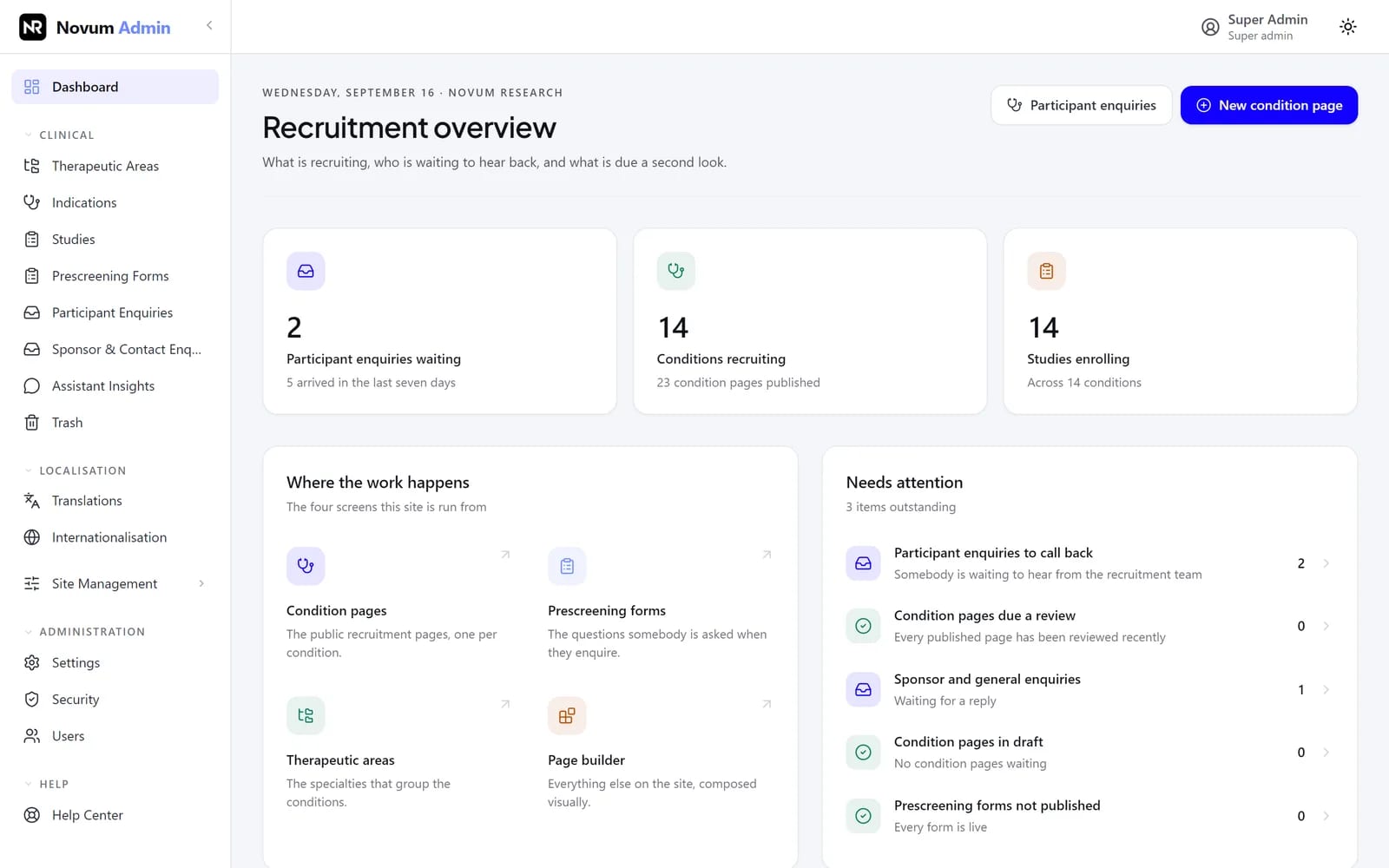
Run by the recruitment team, not by the agency.
The admin opens on a recruitment overview: who is waiting for a call back, which pages are due a review, what is in draft. Everything a coordinator needs is a click away, and nothing they should not touch is visible to them.
Under the hood
A platform, not a plugin stack.
The outcome
A recruitment platform the site owns,
ready for every study that comes next.
A page for every condition
Launching a new study is now a coordinator task: create the page, attach the form, set the study to enrolling. No web designer required.
Enquiries that go somewhere
Every enquiry is stored with its consent, tracked by status, and delivered to eClinPro as a routed lead instead of an email to chase.
Trust built in
Privacy controls, access grants and AI guardrails that make the platform something a sponsor, an IRB and a patient can all be comfortable with.
What this means for your organisation
If your website has to recruit, qualify
and protect the people it reaches,
we build that kind of platform. Research sites, clinics and healthcare organisations get a system designed around their real workflow, their integrations and their compliance obligations, not a template with a form on it.
Book a strategy call with Incep Digital ↗